
Choosing a Chinese Name
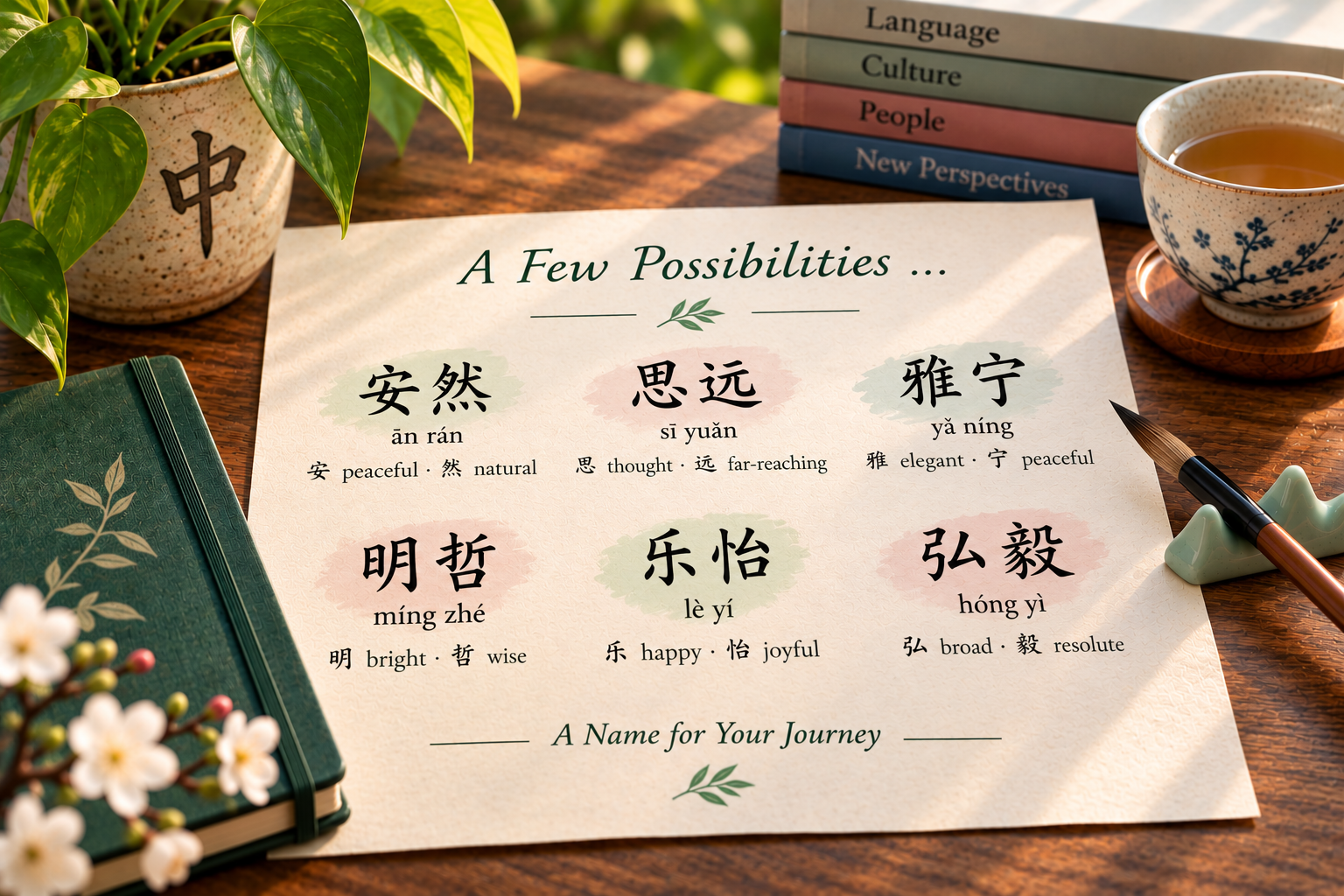
One of the first questions many Mandarin students ask is: “What is my name in Chinese?”
The answer may be more interesting than you expect.
Some familiar English names have well-established Chinese versions. For example:
Anna → 安娜 Ānnà
David → 大卫 Dàwèi
These Chinese versions were created mainly to represent the sounds of the original names.
But not every English name has one standard Chinese equivalent. And even if yours does, that doesn't necessarily mean it has to become your Chinese name.
If you're learning Mandarin, you have choices.
You might choose a Chinese name that sounds somewhat like your English name. You might choose characters because their meanings or associations appeal to you. Or you might look for a name that does a little of both.
And that's where the art of choosing a Chinese name begins.
How Chinese Names Work
Chinese names are usually written with the family name first, followed by the given name.
For example: 王明 Wáng Míng
王 Wáng is the family name.
明 Míng is the given name.
Most Chinese surnames consist of one character, while given names commonly consist of one or two characters.
Foreign names, however, may look quite different when they are written in Chinese. They are often transliterated—represented according to their sounds, syllable by syllable, using Chinese characters.
For example, Elizabeth Taylor is known in Chinese as: 伊丽莎白·泰勒 Yīlìshābái · Tàilè
You can see that this doesn't follow the typical pattern of a Chinese name. Its purpose is to represent the sounds of Elizabeth Taylor in Chinese.
Many people who study Mandarin choose something different for themselves: a name that follows a more typical Chinese pattern, with an established Chinese surname followed by a one- or two-character given name.
What About the Surname?
If you decide you'd like a Chinese-style name, the surname is one of the first things to consider.
But you can't simply choose any character you like and make it your surname. Chinese surnames are established family names, and many Chinese characters are not used as surnames. 王 Wáng, 李 Lǐ, 张 Zhāng, 刘 Liú, and 陈 Chén are just a few examples of common Chinese surnames. There are many others to choose from, and you don't need to limit yourself to the most common ones.
When choosing one for yourself, you might look for a surname that has some connection to the sound of your own name, one whose associations appeal to you, or simply one that works particularly well with the given name you eventually choose.
Sound, Meaning—or Both?
Suppose your name is Anna.
You could use the familiar Chinese transliteration:
安娜 Ānnà
It approximates the sound of Anna using Chinese characters.
But perhaps you'd prefer a Chinese name that is quite different from your English name. You might choose characters that express an idea or quality that is meaningful to you.
Or you might want to find a name that gives you some connection to the sound of your original name and characters with meanings or associations you find appealing.
There isn't always one “correct” choice.
The Art of Choosing a Chinese Name
This is where things get interesting.
Choosing a Chinese name can involve balancing several considerations:
Sound. Does the name sound pleasant, and do you want it to have some connection to your English name?
Meaning. What meanings or associations do the characters carry?
Naturalness. Do the characters work together in a way that sounds like a real Chinese name?
Positive associations. Traditionally, names may be chosen with favorable or auspicious associations in mind.
The characters themselves. How do they look and sound together? Are they commonly used in names?
Practicality. Are the characters reasonably easy for you to recognize, remember, and write?
The complete name. Does the given name work well with the surname?
Before You Choose
Once you've found a name you like, it's a good idea to ask a knowledgeable Chinese speaker or teacher to look at it.
Characters that seem perfect individually may have unexpected associations when combined. A name might sound unusual, old-fashioned, or simply not much like a person's name to a native speaker.
A little guidance can help you find something that works well in Chinese while still feeling like your name.
Your Chinese Name Is Part of the Adventure
Choosing a Chinese name can be one of the fun parts of beginning Mandarin. Along the way, you start noticing how sounds, characters, meanings, and culture all work together.
And you don't have to figure it all out at once.
In Beginner Mandarin Foundations, we'll explore Chinese names as part of learning how Mandarin works. You'll have a chance to think about what you might want in a Chinese name—and, if you'd like, choose one of your own.