
How Mandarin Tones Work: A Beginner-Friendly Explanation
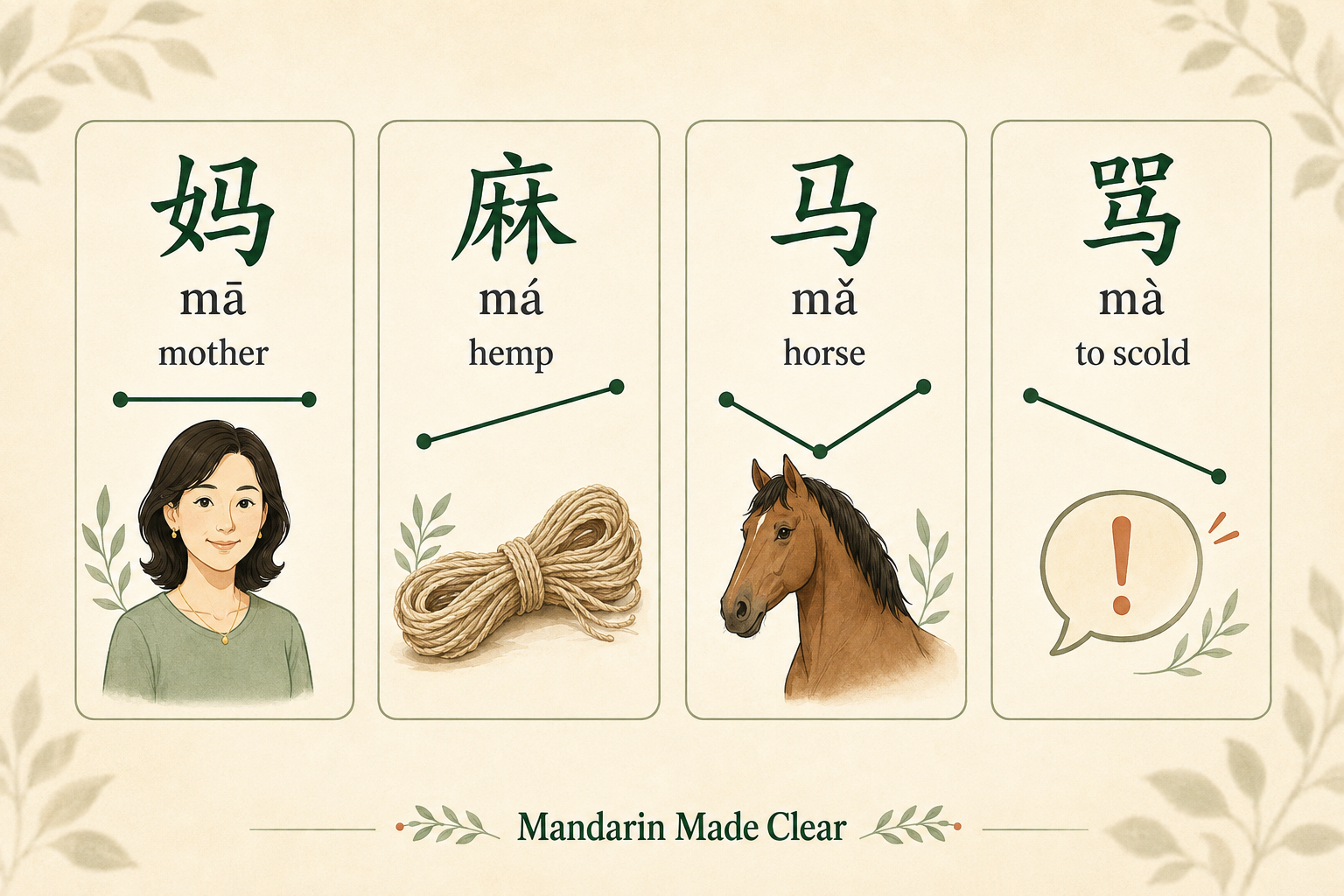
If you are beginning Mandarin, tones may seem like one of the most unfamiliar parts of the language. English speakers use changes in pitch to express emotion, emphasis, or whether something is a question. In Mandarin, the pitch pattern of a syllable can help determine the word’s meaning.
That may sound intimidating, but tones are not random. They are patterns you can learn through clear explanation, careful listening, and regular practice. You do not need perfect tones before you begin speaking. You do need to notice them and practice them from the beginning.
What is a Mandarin tone?
A tone is the pitch pattern used when pronouncing a syllable. Standard Mandarin has four main tones, plus a light neutral tone.
In pinyin, marks above the vowels show the tone:
First tone: mā
Second tone: má
Third tone: mǎ
Fourth tone: mà
Neutral tone: ma
The spelling tells you the basic sound of the syllable. The tone mark tells you how its pitch moves.
The first tone: high and level
The first tone stays high and steady. Imagine holding one clear musical note without letting it rise or fall.
Example:
妈 (mā) — mother
Keep your voice level: mā.
Avoid beginning too low or letting your voice fall at the end. The goal is a smooth, even sound.
The second tone: rising
The second tone rises from the middle of your voice range to a higher pitch. It can resemble the upward movement English speakers sometimes use when asking “Really?”
Example:
麻 (má) — hemp
Let your voice rise clearly: má.
Make sure the syllable begins before the rise. If you start too high, there is nowhere for the pitch to go.
The third tone: low
The third tone is often introduced as a falling-then-rising tone. That full pattern is useful when practicing a syllable by itself. In normal conversation, however, the third tone often stays low rather than completing a dramatic rise.
Example:
马 (mǎ) — horse
Let your voice settle into a low pitch: mǎ.
This is an important point for beginners: do not force every third tone into an exaggerated dip and rise. Listen to how it sounds in a complete phrase and copy the recording.
The fourth tone: sharply falling
The fourth tone begins high and falls quickly and decisively.
Example:
骂 (mà) — to scold
Let your voice fall firmly: mà.
The movement should be clear, but it does not need to sound angry. Focus on the direction of the pitch rather than adding extra force.
The neutral tone: light and short
Some syllables are pronounced lightly, without one of the four full tone patterns. This is called the neutral tone. It is written without a tone mark.
Example:
妈妈 (māma) — mother/mom
The first syllable has a full first tone. The second syllable is shorter and lighter: māma.
The neutral tone is not simply “no pronunciation.” It still has a natural pitch influenced by the syllable before it. Beginners should focus first on making it brief and unstressed.
Do tones really change meaning?
Yes. The syllables mā, má, mǎ, and mà use the same basic consonant and vowel sounds, but their tones distinguish different words.
However, real communication is not a test in which one imperfect syllable automatically ruins the conversation. Context, grammar, and the rest of the sentence also help listeners understand you.
The practical goal is not to become afraid of every tone. It is to build good habits:
Learn the tone together with each new word.
Listen before relying on an English approximation.
Say the word aloud, not only in your head.
Practice short phrases rather than isolated syllables alone.
Ask for feedback and adjust gradually.
Why tones sometimes change in speech
Written tone marks show the standard tone of each word, but some tones change when words are spoken together. These changes help Mandarin flow naturally.
For example:
你好 (nǐ hǎo) — hello
Both syllables are written with third tones. In natural speech, the first third tone changes so that the phrase sounds more like ní hǎo, while the written pinyin remains nǐ hǎo.
Another example is:
不客气 (bú kèqi) — you’re welcome
The word 不 is normally written bù with a fourth tone. Before another fourth-tone syllable, it changes in speech to the rising second tone bú.
You do not need to memorize every tone-change rule at once. Start with common expressions, listen carefully, and learn the pattern as part of the complete phrase.
A simple way to practice Mandarin tones
Try this five-minute routine:
Choose one short phrase with a reliable recording.
Listen once without speaking.
Listen again while following the characters and pinyin.
Repeat slowly, copying the pitch movement.
Repeat at a natural speed.
Record yourself once and compare it with the original.
Use the phrase in a short sentence or exchange.
This method trains listening and speaking together. It is more useful than staring at tone marks without hearing how the phrase actually sounds.
Common beginner mistakes
Treating tones as optional
Tones are part of Mandarin pronunciation, not an extra feature to add later. Begin noticing and practicing them from your first lesson.
Memorizing words without their tones
Learn nǐ hǎo, not just “ni hao.” The tone is part of the word.
Exaggerating every tone
Large pitch movements can help during early practice, but natural speech is smoother. Use recordings as your guide.
Depending only on English sound approximations
English approximations can provide a starting point, but they cannot represent Mandarin sounds and tones accurately. Listen and imitate whenever possible.
Expecting perfection immediately
Accurate pronunciation develops through repeated listening, practice, and feedback. Aim for steady improvement and understandable speech.
Start using tones in real phrases
The best way to understand Mandarin tones is to hear and use them in meaningful language. Begin with phrases you can say right away, and practice them consistently instead of trying to master the entire tone system in one sitting.
Try the free 5-Day Mandarin Starter Challenge for useful phrases with audio, pinyin, pronunciation guidance, and quick speaking practice.
For a complete, structured learning path covering pronunciation, pinyin, tones, conversation, grammar, and Chinese characters, learn more about the Beginner Mandarin Foundations class.