
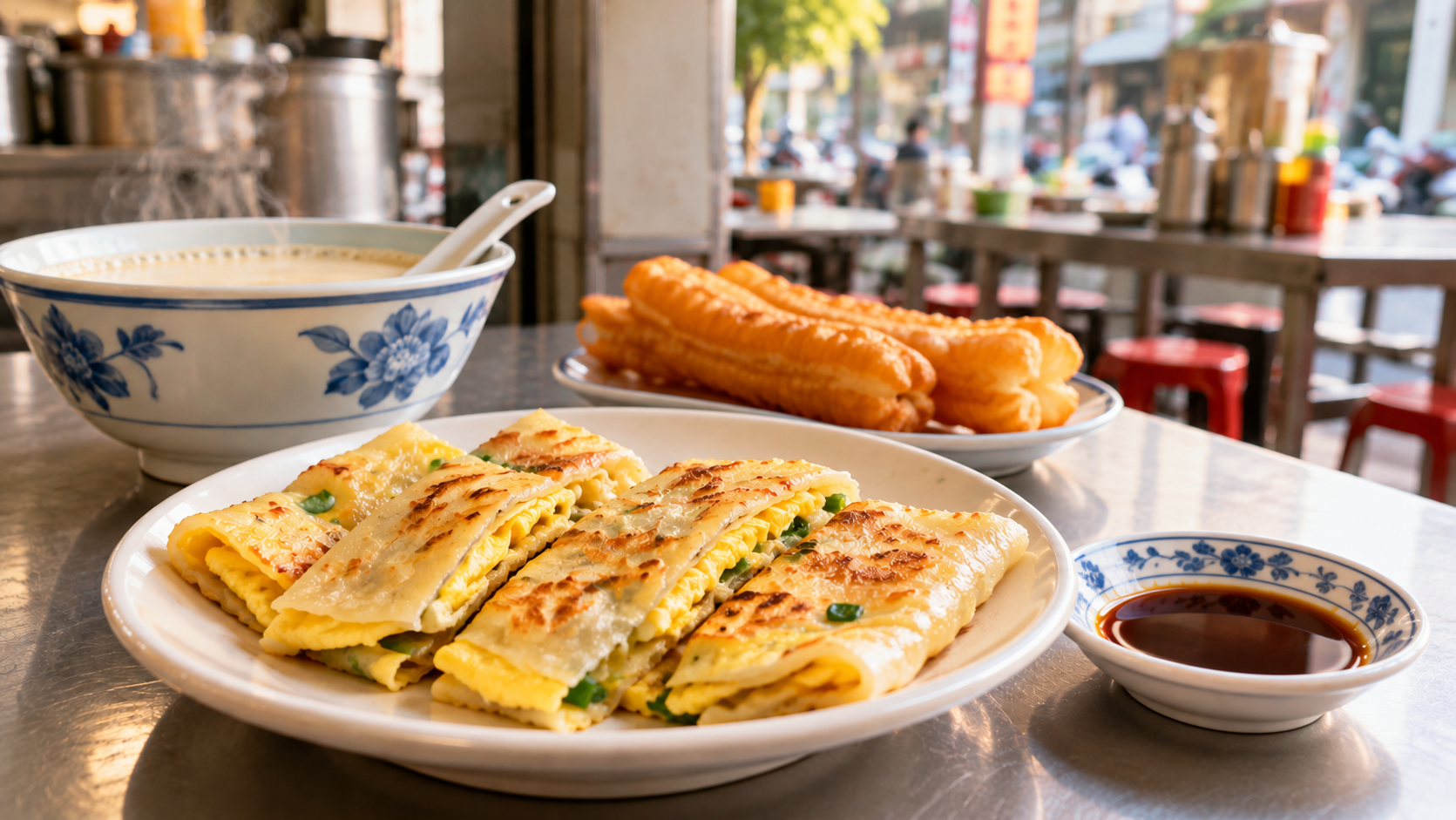
Hot soy milk, “oil fritters,” and egg pancakes — My first breakfast in Taiwan is one I have never forgotten.
I had just arrived and was thoroughly jet-lagged. After a rather strange night in a home on Yangmingshan (陽明山), I found myself eating breakfast in a space that, to me, looked remarkably like a garage. I remember a large garage-style door rolled up overhead, leaving the room open to the outside. Chickens wandered freely in and out.
A friend who had already lived in Taiwan for some time was with us. Our Chinese was practically nonexistent, so he handled the ordering. He asked if we wanted to try 豆浆 dòujiāng, soy milk, and what he called “oil fritters” — 油条 yóutiáo.
I still remember that phrase: oil fritters.
There were 蛋饼 dànbǐng, too: Taiwanese egg pancakes that were nothing like the pancakes we knew.
The setting was unfamiliar. The food was unfamiliar. Pretty much everything was unfamiliar.
And it was my introduction to Taiwanese breakfast.
So, What Is a Taiwanese Breakfast?
As I would discover, the foods that seemed so unfamiliar that first morning were anything but unusual in Taiwan. 豆浆、油条 and 蛋饼 are all familiar breakfast foods, and breakfast shops are part of everyday life.
Of course, there isn’t just one Taiwanese breakfast. Walk into a breakfast shop and you may find egg pancakes, steamed buns, rice rolls, turnip cakes, sandwiches, soy milk, and plenty of other choices. Some have deep roots in Chinese food traditions; others reflect the particular history and changing tastes of Taiwan.
For a Mandarin learner, breakfast is also a great place to start using the language. You don’t need complicated Chinese to recognize a few foods, ask what is available, and place a simple order.
A Quick Note About the Chinese Characters
Mandarin Made Clear primarily teaches simplified Chinese characters and uses the forms commonly encountered in mainland-focused Mandarin courses. Taiwan, however, uses traditional Chinese characters.
So in Taiwan you’ll see:
豆漿 · 油條 · 蛋餅
At Mandarin Made Clear, we normally write these as:
豆浆 · 油条 · 蛋饼
In this article, we’ll continue to use simplified characters for consistency, while showing the traditional forms when they’re especially useful to recognize.
Three Taiwanese Breakfast Classics
Let’s take a closer look at the three foods I encountered that first morning.
豆浆 dòujiāng — Soy Milk
豆浆 dòujiāng is soy milk, but if your only experience with soy milk is the kind you buy in a carton at an American supermarket, don’t assume you already know what to expect.
The 豆浆 at my first Taiwanese breakfast certainly wasn’t what I expected. It arrived steaming hot and quite sweet, served in a bowl with a Chinese flat-bottomed spoon. Even the takeout version surprised me: I remember watching people leave with hot soy milk in plastic bags, closed tightly around a straw. Hot milk in a bag!
Fresh soy milk is a common breakfast drink in Taiwan and elsewhere in the Chinese-speaking world. It can be served hot or cold, sweetened or unsweetened.
You’ll often see it alongside 油条, which brings us to the food whose English name I have remembered all these years.
油条 yóutiáo — “Oil Fritters”
油条 yóutiáo are long strips of dough fried until golden, with a crisp exterior and a light, airy interior.
Today, I would probably describe them in English as fried dough sticks. But on that first morning, my friend called them “oil fritters,” and oil fritters they have remained in my memory ever since.
油条 are often eaten with soy milk. You can eat them alongside it or dip pieces into the warm 豆浆.
蛋饼 dànbǐng — Egg Pancakes
Then there was 蛋饼 dànbǐng, one of the foods I would come to associate especially strongly with breakfast in Taiwan.
Despite the usual English translation “egg pancake,” don’t picture an American breakfast pancake. In Taiwan, 蛋饼 is more like a soft, tortilla-like wrapper with a thin layer of beaten egg cooked onto it, then rolled or folded and cut into pieces. It is often served with a savory soy-based sauce for dipping or drizzling.
On that first morning in Taiwan, my friend did the ordering for us. Fortunately, you don’t need much Mandarin to order a simple breakfast yourself.
Ready to Order Breakfast?
Here are a few phrases to get you started:
你们有蛋饼吗? Nǐmen yǒu dànbǐng ma? Do you have egg pancakes?
我要一个蛋饼。 Wǒ yào yí ge dànbǐng. I’d like one egg pancake.
我要一杯豆浆。 Wǒ yào yì bēi dòujiāng. I’d like a cup of soy milk.
我要一根油条。 Wǒ yào yì gēn yóutiáo. I’d like one fried dough stick.
这个多少钱? Zhège duōshao qián? How much is this?
Listen to the breakfast vocabulary and ordering phrases, each repeated three times, then practice saying them aloud.
From Unfamiliar to Familiar
I needed a friend to order my first Taiwanese breakfast for me. But that’s one of the pleasures of learning even a little Mandarin — foods that once seemed completely unfamiliar begin to have names you recognize and remember, and before long, you can order them for yourself.
Want to learn more?
Beginner Mandarin Foundations takes you step by step from your first words in Mandarin to simple, practical conversations like these. Learn more about Beginner Mandarin Foundations.